Buy a Custom Soldier Chinese or Japanese Calligraphy Wall Scroll
We have many options to create artwork with the Chinese characters / Asian symbols / Japanese Kanji for Soldier on a wall scroll.
See also: Warrior | Fighter | Military Proverbs of Ancient Asia
1. Soldiers
2. American Soldier / American Serviceman
3. Marine / Soldier of the Sea
4. Military Veteran / Retired Soldier
9. Warrior Monk / Soldier Priest
10. Warrior of God / Soldier of God
11. Ghost Warrior
13. Army / Military
Soldiers
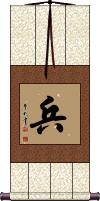
兵 can be used to express soldiers, troops, a force, an army, weapons, arms, military, warfare, tactics, strategy, or warlike.
The final meaning depends on context. It's also part of the Chinese title for the Terracotta soldiers. In fact, this character is usually used in compound words (words of more than one character). Sometimes this single character is the title used for the pawns in a chess game (in a related issue, this is also a nickname for soldiers with the rank of Private).
American Soldier / American Serviceman
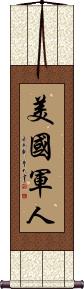
美國軍人 means “American Soldier” or literally “American Military Person.”
This can also be translated as “American military personnel,” or “American serviceman.” Gender is not specified in this title, so it's appropriate for male or female soldiers.
Marine / Soldier of the Sea
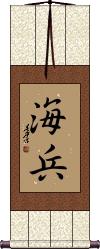
海兵 is a way to express “Marine” as in an individual “Soldier of the Sea” in Japanese Kanji and old Korean Hanja characters (not to be confused with Korean Hangul).
Breaking down each character, this means:
“ocean/sea soldier/army/warrior.”
Please note that this Japanese/Korean version kind of means “sailor” or “navy” in Chinese.
See Also: Military
Military Veteran / Retired Soldier
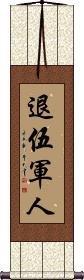
退伍軍人 is the Chinese title for a military veteran.
The first two characters mean “retired from the ranks,” or discharged.
The last two characters mean serviceman, soldier, or military personnel.
Soldier / Private
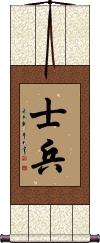
士兵 means “Soldier” but more specifically, a rank-and-file soldier (a private or troop - you could say a ground-pounder). Our other entry for “solider / serviceman” is probably better for a wall scroll (since someday, you will be promoted).
Note: In Japanese, they use these characters in the opposite order to create the same meaning word. In that order, it's pronounced “heishi” in Japanese. Just let us know if you want it in Japanese Kanji order when you place your order.
Soldier of the Gods
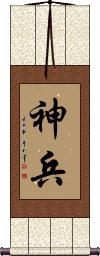
神兵 is a Japanese, Chinese, and Korean title that means “soldier dispatched by a god,” or “soldier under the protection of the gods.”
神兵 is used more in Japanese (especially in animation) than the other languages.
Soldier of Fortune
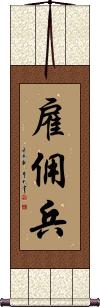
雇佣兵 is “soldier of fortune” in Chinese.
It can also be read as “mercenary” or “hired gun.”
Soldier of Fortune
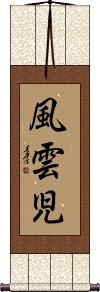
風雲児 is “soldier of fortune” in Japanese.
It can also be read as “lucky adventurer” or “adventurer who takes advantage of troubled times.”
Soldier / Serviceman
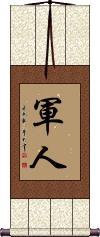
軍人 means “Soldier” or literally “Military Person.”
This can also be translated as “military personnel,” “soldier,” or “serviceman” (it is unisex, so male or female is not indicated).
See Also: Military
Warrior Monk / Soldier Priest
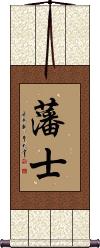
藩士 is a strange title for a wall scroll, but it may suit you if you see yourself as a warrior monk.
This title is not commonly used but will be understood in Chinese and Japanese. It can also be read as “armed monks.”
Warrior of God / Soldier of God
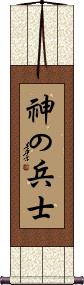
神の兵士 means “Warrior of God” or “Soldier of God” in Japanese.
Ghost Warrior
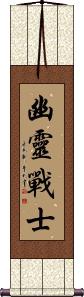
幽靈戰士 means Ghost Warrior or Ghost Soldier in Chinese.
This title is used for at least one movie and a video game (about a sniper).
Active Duty Military
Person on Active Duty
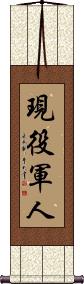
現役軍人 means “Active Duty Soldier” or literally “Active Duty Military Person.”
This title is a great way to show pride in being an active duty member of the armed forces.
The first two characters mean “active duty” and the second two characters can be translated as “military personnel,” “soldier,” or “serviceman” (it is unisex, so male or female is not indicated).
See Also: Military
Army / Military
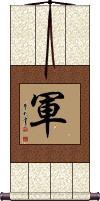
軍 means army, military, or arms.
軍 is also a character used in the compound word that means “army general.” It's the “gun” in the well-known Japanese title “Shogun” which means general.
This in-stock artwork might be what you are looking for, and ships right away...