Buy Perseverance Chinese / Japanese Calligraphy Art
We have many options to create artwork with Perseverance characters on a wall scroll or portrait.
1. Perseverance
3. Kenninfubatsu - Indomitable Perseverance
5. Patience / Perseverance / To Endure / Tolerant
8. Perseverance / Indomitable / Invincible Fortitude
10. Bounce Back / Stage a Comeback
12. Failure is the Origin of Success
13. Failure is the Mother of Success
14. Fall Down Seven Times, Get Up Eight
15. Fortitude / Strength of Character
16. Gaman
17. Heaven Blesses the Diligent
20. Never Give Up
21. Never Give In / Never Succumb / Never Lose
22. No Pain No Gain
23. Patience Yields Peace of Mind
24. Even an iron bar can be ground to a needle
25. Persistence
26. Undaunted After Repeated Setbacks
27. Phoenix Rise from the Ashes
28. There is no pleasure without pain
31. Resilience / Restoration / Recovery
32. Spare No Effort
33. Always Striving for Inner Strength
34. Strong bones come from hard knocks
35. Strong Hearted / Strong Willed
36. Failure is a Stepping Stone to Success
37. Unwavering
38. Overcome: Regardless of the Rain and Wind
39. Regardless of the Weather, We Overcome Troubles Together
40. To a Willing Heart, All Things Are Possible
41. Where there’s a will there’s a way
43. Each Time You Stumble and Fall, You Gain Experience and Wisdom
Perseverance
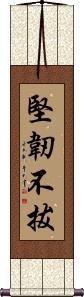
堅韌不拔 is about perseverance, being steadfast and persistent.
堅韌不拔 is a great phrase for you if you commit to your goals and overcome obstacles, no matter how long it takes.
The translation of this proverb literally means “something so persistent or steadfast, that it is not uprootable, movable, or surpassable.”
Other translations include being firm and indomitable or tenacious and unyielding.
See Also: Tenacious | Devotion | Persistence | Indomitable
Perseverance
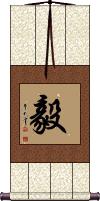
毅 is the simplest way to express perseverance in Chinese and Korean Hanja.
This single-character version leaves a bit of mystery about what kind of perseverance you might want to convey.
In Korean, this is usually associated with “strength of character.”
In Japanese, this character can be pronounced in a dozen different ways (so we have left out the Japanese pronunciation guide that normally appears above). In Japanese, this Kanji would usually be translated as “strong” (perhaps strong-willed).
Perseverance / Fortitude
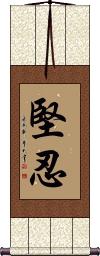
堅忍 means persistent, steadfast, fortitude, and/or perseverance.
The first character means strong, solid, firm, unyielding, or resolute.
The second character means to beat, endure, or tolerate.
Together they speak of the strength from within yourself. Some may also translate this as long-suffering in a more Biblical sense.
堅忍 is a common term in Chinese and Korean Hanja but a little less commonly used in modern Japanese Kanji. For that reason, this selection is best if your audience is Chinese or Korean.

 Note that when writing this as Kanji, Japanese will tend to write the second Kanji a little differently. If you select our Japanese master calligrapher, please expect the form where the little horizontal stroke crosses the vertical stroke. See differences in the images to the right. Technically, they are both the same character, and will be read the same in either language.
Kenninfubatsu - Indomitable Perseverance

堅忍不抜 means indomitable perseverance or invincible fortitude in Japanese Kanji.
Patience / Perseverance
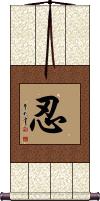
忍 contains the ideas of patience, equanimity, perseverance, forbearance, and endurance. Alone, this single character can be a bit ambiguous or flexible. It can also mean to endure, to bear, to put up with, or to conceal. If you want to simply decide what this character means to you within the general meaning but keep it a mystery to others, this is a good choice.
If you want to be more direct, you may want to choose one of our other selections that mean perseverance or patience (you will see this character within those larger words/phrases).
There is a secondary meaning in Japanese since this is the first character of the word ninja.Note that when writing this as Kanji, Japanese will tend to write it in the form shown to the right. If you select our Japanese master calligrapher, please expect this Kanji form (yes, it's just one stroke that is slightly different in location, crossing another stroke in the Japanese Kanji form).
Patience / Perseverance / To Endure / Tolerant
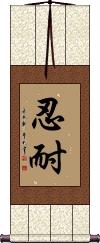
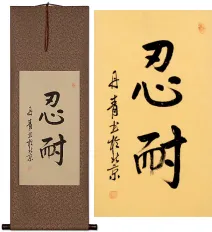
忍耐 is patience, the quiet hope, and trust that things will turn out right.
You wait without complaining. You are tolerant and accepting of difficulties and mistakes. You picture the end in the beginning and persevere to meet your goals.
忍耐 can also mean “to endure,” “restrain oneself,” or “forbearance,” and in some contexts, it can mean “perseverance” or “endurance.”
忍耐 is also used as a tenet of Taekwondo, Tang Soo Do, and other Korean martial arts where it's titled “Endurance” and romanized as “In Neh.”
Note that when writing this as Kanji, Japanese will tend to write the first character in the form shown to the right. If you select our Japanese master calligrapher, please expect this Kanji form (yes,
it’s
just one stroke that is slightly different in location, crossing another stroke in the Japanese Kanji form).
Perseverance / Fortitude
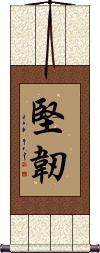
Perseverance / Will-Power
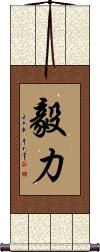
毅力 is a way to express “perseverance” with the idea of “willpower” in Chinese and old Korean Hanja. It can also mean “strong-willed.”
The first character means “strong” and “persistent,” while the second means “strength” and “power.”
Perseverance / Indomitable / Invincible Fortitude

堅忍不抜 means determined, steadfast, unswerving, or unshakable in Japanese.
This is the Japanese version of an old Chinese 4-character perseverance proverb.
This would be understood in Chinese, but it's not commonly written this way in Chinese.
Note that when writing this as Kanji, Japanese calligraphers sometimes write the second Kanji in the form shown to the right. Yes,
it’s
just one stroke that is slightly different in location, crossing another stroke in this alternate Japanese Kanji form. If you have a preference, let us know when you order.
Due to some odd computer coding conventions, these two character forms were combined/merged into the same code point - thus, you will not see Kanji images of more Japanese form as you select options for your scroll.
Perseverance is the Key
Skills cannot be perfected without perseverance in practice
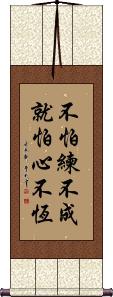
不怕练不成就怕心不恒 literally translates as: Do not worry about not being able to master [a skill]; What [one should] be concerned about is lack of perseverance.
Figuratively, this means: One's skills cannot be perfected without perseverance in practice.
For me, I've learned that you can only get so much from school or studying. You've really got to do “on-the-job training” to perfect your ability and skill.
For martial arts students: You can read about a kick in a book, or someone can tell you about a certain kick but until you practice the kick, there's no way you'll master it.
Bounce Back / Stage a Comeback
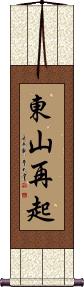
東山再起 is a Chinese proverb that means “make a comeback” or “resuming after a failure.”
It's sometimes used in terms of losing a job and then getting it back. However, it applies to any kind of comeback after difficulty.
The literal meaning of this Chinese idiom is, “[The] Eastern Mountain Again [will] Rise.”
Determination to Achieve
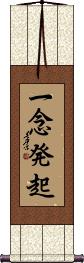
一念発起 is a Japanese proverb, “Ichinen Hokki,” which suggests being resolved to do something or having a wholehearted intention to accomplish something.
Some will translate this as “the determination to accomplish something,” or “turning over a new leaf and being determined to find success.”
Failure is the Origin of Success
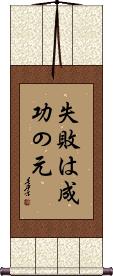
This Japanese proverb reads, “failure/mistake/blunder/defeat is the origin of success.”
It suggests that failures or defeats are a necessary part of success.
失敗は成功の元 is often translated as “Failure is a stepping stone to success.”
Note: There are a few similar variations of this idiom in Japanese.
Note: Because this selection contains some special Japanese Hiragana characters, it should be written by a Japanese calligrapher.
See Also: Failure is a Stepping Stone to Success
Failure is the Mother of Success
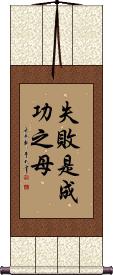
失败是成功之母 is a Chinese and Korean proverb that means “Every failure that you experience is a chance to learn from it and find success.”
Knowing what does not work is just as important as finding out what does work.
See Also: Experience is the Mother of Wisdom
Failure is the Mother of Success
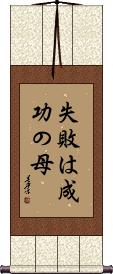
失敗は成功の母 is a Japanese proverb that means exactly what you think.
Every failure that you experience is a chance to learn from it and find success.
Knowing what does not work is just as important as finding out what does work.
Note: This is the Japanese version of an ancient Chinese proverb.
Note: Because this selection contains some special Japanese Hiragana characters, it should be written by a Japanese calligrapher.
See Also: Experience is the Mother of Wisdom
Fall Down Seven Times, Get Up Eight
Always rising after a fall or repeated failures
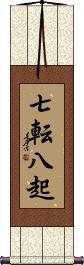
七転八起 is a Japanese proverb that relays the vicissitudes of life, with the meaning “seven times down eight times up.”
Some would more naturally translate it into English as “Always rising after a fall or repeated failures” or compare it to the English, “If at first, you don't succeed, try, try again.”
The first Kanji is literally “7.” The second means “fall down” (sometimes this Kanji means “turn around,” “revolve” or “turn over” but in this case, it holds the meaning of “fall”). The third is “8.” And the last is “get up,” “rouse,” or “rise.”
Basically, if you fail 7 times, you should recover from those events and be prepared to rise an 8th time. This also applies if it is the world or circumstances that knock you down seven times...
...just remember that you have the ability to bounce back from any kind of adversity.
Note: This can be pronounced in two ways. One is “shichi ten hakki” or “shichitenhakki.” The other is “nana korobi ya oki” also written, “nanakorobi-yaoki.”
Special Note: The second character is a Kanji that is not used in China. Therefore, please select a Japanese calligrapher for this title.
Fortitude / Strength of Character
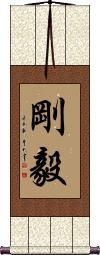
剛毅 is a Japanese and Chinese word that means resolute and firm, fortitude, firmness of character, hardihood, manliness, or macho.
Gaman
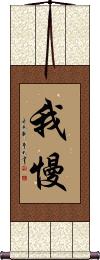
Gaman is a Zen Buddhist term from Japan that means “enduring the seemingly unbearable with patience and dignity.”
This title can also be translated as patience, perseverance, tolerance, or self-denial.
我慢 is also a Chinese Buddhist term with a different pronunciation. It comes from Sanskrit abhimāna or ātma-mada. Chinese Buddhism defines this very differently as “Egoism exalting self and depreciating others,” “self-intoxication,” or “pride.” Alone, the first character means “Me, I, or Self,” and the second character in a Buddhist context comes from Sanskrit māna and means pride, arrogance, self-conceit, looking down on others, superciliousness, etc.
I’m currently working with Japanese and Chinese translators to try and reconcile the true meaning or any commonality of this word between languages. For now, please only consider this if your audience is Japanese.
Heaven Blesses the Diligent
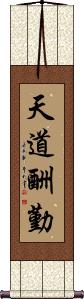
天道酬勤 can be interpreted in a few different ways:
God blesses those who work hard.
It is the way of Heaven to smile on the diligent.
God will reward those that are worthy.
Heaven blesses those who are diligent.
Whichever translation you like, a scroll like this on your wall may serve as a reminder to work hard because your diligence will pay off both in this life and the next.
Note: This can be pronounced in Korean, but it's not a commonly used term.
Indomitable / Unyielding
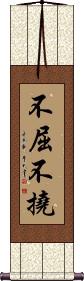
不屈不撓 means “Indomitable” or “Unyielding.”
不屈不撓 is a long word by Chinese standards. At least, it is often translated as a single word into English. It's actually a proverb in Chinese.
If you want to break it down, you can see that the first and third characters are the same. Both mean “not” (they work as a suffix to make a negative or opposite meaning to whatever character follows).
The second character means “bendable.”
The last means “scratched” or “bothered.”
So this really means “Won't be bent, can't be bothered.” I have also seen it written as “Will not crouch, will not submit.” This comes from the fact that the second character can mean “to crouch” and the last can mean “to submit” (as in “to give in” such as “submitting to the rule of someone else”). This may explain better why these four characters mean “indomitable.”
Notes:
Some will translate this as “indomitable spirit”; however, technically, there is no character to suggest the idea of “spirit” in this word.
Other translations include indefatigability, indomitableness, or unremitting tenacity.
The first two characters can be stand-alone words in Chinese.
In Japanese, this is considered two words (with very similar meanings). It's more common to see the word order flipped to 不撓不屈 in Japanese.
The same characters are used in old Korean Hanja. Just like in Japanese, the words are swapped to 不撓不屈 creating a word pronounced “불요불굴” in Korean.
See 不撓不屈
Indomitable Spirit
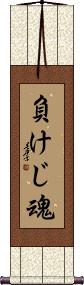
負けじ魂 is a Japanese proverb that means “indomitable spirit” or “unyielding spirit.”
Note: Because this selection contains some special Japanese Hiragana characters, it should be written by a Japanese calligrapher.
Never Give Up
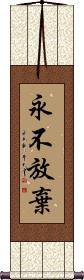
The first character means “eternal” or “forever,” and the second means “not” (together, they mean “never”). The last two characters mean “give up” or “abandon.” Altogether, you can translate this proverb as “never give up” or “never abandon.”
Depending on how you want to read this, 永不放棄 is also a statement that you will never abandon your hopes, dreams, family, or friends.
Never Give In / Never Succumb / Never Lose
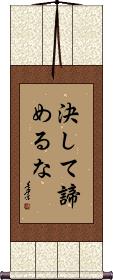
決して諦めるな is a Japanese term that informally means “never give up.”
It's also a Japanese way to say “never surrender.”
Note: Because this selection contains some special Japanese Hiragana characters, it should be written by a Japanese calligrapher.
No Pain No Gain
Literally: No Pain, No Strength
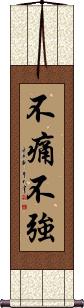
不痛不強 is a proverb that is close to our idea of “no pain, no gain” in English. It holds this meaning in the context of working out at the gym etc.
不痛不強 means “no pain, no strength,” meaning that if you don't experience a little pain, you will not gain any strength.
No Pain No Gain
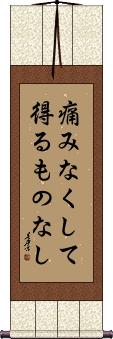
痛みなくして得るものなし is a Japanese phrase that means “no pain, no gain.”
This suggests that with pain, a gain must follow.
The pain Kanji here can also be translated as sorrow or suffering. The gain can also mean profit, advantage, or benefit. In the Japanese Buddhist context, that gain Kanji can mean rebirth in paradise, entering nirvana.
The character breakdown:
痛みなく (itami naku) pain; ache; sore; grief; distress. The naku part adds the meaning of “a lot of” or “extended”
して (shite) and then. (indicates a causative expression; acts as a connective particle)
得る (eru) to get; to acquire; to obtain; to procure; to earn; to win; to gain; to secure; to attain.
もの (mono) conjunctive particle indicating a cause or reason.
なし (nashi) none of; -less; without; no.
Note: Because this selection contains some special Japanese Hiragana characters, it should be written by a Japanese calligrapher.
Patience Yields Peace of Mind
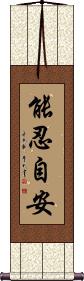
This ancient Chinese proverb can be translated as “Patience brings peace of mind,” “One who has patience finds peace,” and a few other ways.
Even an iron bar can be ground to a needle
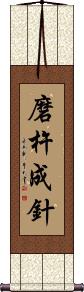
磨杵成針 is a Chinese proverb that means “to grind an iron bar down to a fine needle,” or “Even a bar of iron can be ground down to a needle [with perseverance].”
Figuratively, this means to persevere in a difficult task or to study diligently.
Persistence
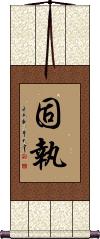
固執 can also mean “opinionated” or “stubborn” in Chinese and Japanese, but in the nicest way possible (still bad).
This just means “stubborn” in Korean (not a good scroll if your audience is Korean, in fact, we don't recommend this word at all). There are better ways to express this idea, such as tenacity/tenacious or perseverance... ...see the links below...
Undaunted After Repeated Setbacks
Persistence to overcome all challenges
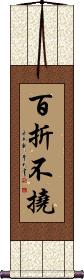
百折不撓 is a Chinese proverb that means “Be undaunted in the face of repeated setbacks.”
More directly translated, it reads, “[Overcome] a hundred setbacks, without flinching.” 百折不撓 is of Chinese origin but is commonly used in Japanese and somewhat in Korean (same characters, different pronunciation).
This proverb comes from a long, and occasionally tragic story of a man that lived sometime around 25-220 AD. His name was Qiao Xuan, and he never stooped to flattery but remained an upright person at all times. He fought to expose the corruption of higher-level government officials at great risk to himself.
Then when he was at a higher level in the Imperial Court, bandits were regularly capturing hostages and demanding ransoms. But when his own son was captured, he was so focused on his duty to the Emperor and the common good that he sent a platoon of soldiers to raid the bandits' hideout, and stop them once and for all even at the risk of his own son's life. While all of the bandits were arrested in the raid, they killed Qiao Xuan's son at first sight of the raiding soldiers.
Near the end of his career, a new Emperor came to power, and Qiao Xuan reported to him that one of his ministers was bullying the people and extorting money from them. The new Emperor refused to listen to Qiao Xuan and even promoted the corrupt Minister. Qiao Xuan was so disgusted that in protest, he resigned from his post as minister (something almost never done) and left for his home village.
His tombstone reads “Bai Zhe Bu Nao” which is now a proverb used in Chinese culture to describe a person of strong will who puts up stubborn resistance against great odds.
My Chinese-English dictionary defines these 4 characters as “keep on fighting despite all setbacks,” “be undaunted by repeated setbacks,” and “be indomitable.”
Our translator says it can mean “never give up” in modern Chinese.
Although the first two characters are translated correctly as “repeated setbacks,” the literal meaning is “100 setbacks” or “a rope that breaks 100 times.” The last two characters can mean “do not yield” or “do not give up.”
Most Chinese, Japanese, and Korean people will not take this absolutely literal meaning but will instead understand it as the title suggests above. If you want a single big word definition, it would be indefatigability, indomitableness, persistence, or unyielding.
See Also: Tenacity | Fortitude | Strength | Persistence
Phoenix Rise from the Ashes
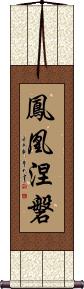
鳳凰涅磐 is a proverb that suggests “Legendary Phoenix rises from the ashes.” It means “Legendary Phoenix [reaches] Nirvana.”
There is a legend in China of a great bird reborn once every 500 years. This bird gathers all the ill will, suffering, desire, and other negative things of the world. The bird then plunges into the fire to burn away all negative things, sacrificing itself in the process (achieving Nirvana, or perhaps allowing others the opportunity to reach Nirvana).
500 years later, the phoenix is reborn from the ashes again, and the cycle repeats.
There is no pleasure without pain
No pain, no gain
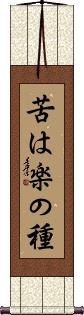
苦は楽の種 is a Japanese proverb that means “One cannot have pleasure without pain.”
It's one of a few Japanese ways to say, “No pain, no gain.”
Note: Because this selection contains some special Japanese Hiragana characters, it should be written by a Japanese calligrapher.
Pursue Your Dreams
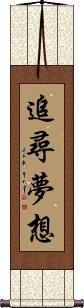
追尋夢想 means “pursue your dreams,” “follow your dreams,” or “chase your dreams” in Chinese.
The first two characters mean “to pursue,” “to track down,” or “to search for.”
The last two mean dreams. This version of dreams refers to those with an element of reality (not the dreams you have when you sleep but rather your aspirations or goals in life).
This title will tell everyone that you want to make your dreams come true.
See Also: Pursuit of Happiness
Pursue Your Dreams
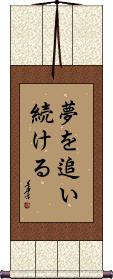
夢を追い続ける is the Japanese way to express “pursue your dreams,” “follow your dreams,” or “chase your dreams.”
If you have dreams that you want to pursue and make true, this is the phrase for you.
The first character is “dream” or “dreams.” The rest of the characters establish the idea of chasing or pursuing.
Note: Because this selection contains some special Japanese Hiragana characters, it should be written by a Japanese calligrapher.
See Also: Pursuit of Happiness
Pursuit of Happiness
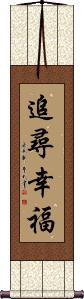
追尋幸福 is the best way to translate the English phrase “pursuit of happiness” into Chinese.
The first two characters mean “to pursue,” “to track down,” or “to search for.”
The last two mean happiness, happy, or being blessed.
See Also: Follow Your Dreams
Resilience / Restoration / Recovery
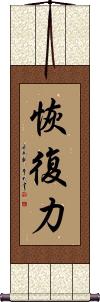
恢復力 suggests having the power to recover, restore, and rehabilitate. This can refer to yourself, someone else, or even to something, like rehabilitating a burned forest. 恢復力 is the essence of resilience in life.
The first two characters are a word that means to reinstate, resume, restore, recover, regain, or rehabilitate, restoration, rehabilitation, recovery, return, improvement, recovery (from an illness), recuperation, or convalescence.
The last character means strength or power.
See Also: Tenacity
Spare No Effort
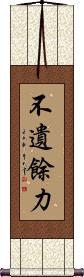
不遺餘力 is a Chinese proverb that can be translated in many ways. Here are some of them: go to any lengths; with all one's might; spare no pain; do one's utmost.
If you feel hard work and holding nothing back is your philosophy, this is the phrase for you.
Always Striving for Inner Strength
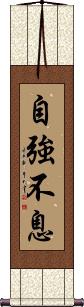
自強不息 is a proverb or idiom that suggests that the pursuit of self-improvement is eternal. It can also be a suggestion to strive unremittingly in life.
The first two characters mean inner strength with the idea of self-improvement. The last two characters mean “never rest” or “striving without giving up.”
Some will translate these four characters as “Exert and strive hard without any let-up.”
Strong bones come from hard knocks
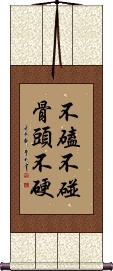
不磕不碰骨頭不硬 is a Chinese proverb that literally translates as: Without being knocked around a bit, [one's] bones won't become hard.
Figuratively, this means: One can't become strong without first being tempered by “hard knocks.”
While true for everyone, this sounds like the “Iron Body” form of Kung Fu, where practitioners' bodies are beaten (and often bone fractured) in order to become stronger.
For the rest of us, this is just about how we can be tempered and build character through the hardships in our lives.
This is not a common title for a wall scroll in China.
Strong Hearted / Strong Willed
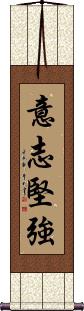
意志堅強 can mean either “strong-hearted,” “strong-willed” or “determination.”
The first two characters can be translated as “will,” “willpower,” “determination,” “volition,” “intention,” or “intent.” But, it should be noted that this first part possesses the element of “heart” in the lower portion of both characters (they also partially carry the meaning “with the whole heart”).
The last two characters mean “strong” or “staunch.”
Chinese word order and grammar are a bit different than English, so in this case, they are in reverse order of English but have the correct meaning in a natural form.
See Also: Strong Willed | Discipline | Will-Power
Failure is a Stepping Stone to Success
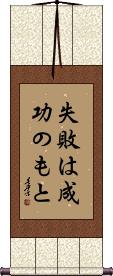
This Japanese proverb literally reads, “failures/mistakes/blunders are the yeast-starter/yeast-mash of success.”
Basically, it suggests that failures are a necessary part of success; Just as bread or beer requires yeast to successfully rise or brew/ferment.
Note: Because this selection contains some special Japanese Hiragana characters, it should be written by a Japanese calligrapher.
Unwavering
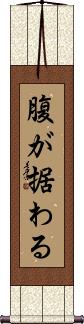
腹が据わる is a Japanese proverb that means to have guts or to be unwavering in one's resolution.
Note: Because this selection contains some special Japanese Hiragana characters, it should be written by a Japanese calligrapher.
Overcome: Regardless of the Rain and Wind
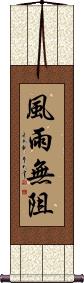
風雨無阻 is a proverb that is often translated as “Go ahead as planned regardless of the weather” or, “[Overcome] despite the rain and wind.”
This is a Chinese proverb that suggests that you are willing (or should be willing) to overcome any adversity, and accomplish your task at hand.
There is a second/optional part to this phrase that suggests that you should do this together with someone (see our other 8-character version if you want the full phrase).
Regardless of the Weather, We Overcome Troubles Together
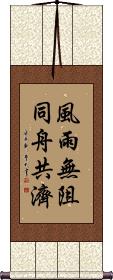
The first four characters are often translated as “Go ahead as planned regardless of the weather” or, “[Overcome] despite the rain and wind.” The last four characters can mean “Stick together” but literally means “Take the same boat [together].”
風雨無阻同舟共濟 is a Chinese proverb that suggests that you are willing (or should be willing) to overcome any adversity, and accomplish your task at hand. The second part (last four characters) is sometimes left off but this second part strongly suggests that you should overcome that adversity together.
To a Willing Heart, All Things Are Possible
Where there is a will, there is a way
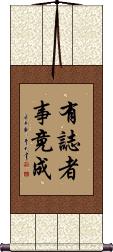
有志者事竟成 is an old Chinese proverb that has been translated many different ways into English. As you read the translations below, keep in mind that in Chinese, heart=mind.
Nothing is impossible to a willing heart.
Nothing is impossible to a willing mind.
Nothing is difficult to a willing heart.
Where there is a will, there is a way.
Nothing in the world is impossible if you set your mind to doing it.
A willful man will have his way.
If you wish it, you will do it.
A determined heart can accomplish anything.
All things are possible with a strong mind.
Where there’s a will there’s a way
persevere and you will succeed
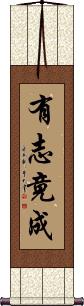
有志竟成 is a Chinese proverb that means “persevere and you will succeed.”
It's very much like the English idiom, “where there's a will, there's a way.”
Stay Strong / Iron Will
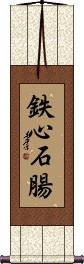
鉄心石腸 is a Japanese proverb that suggests you should have the inner-strength and will as hard and steadfast as iron.
It's the Japanese way of saying, “stay strong.” This is an especially uplifting thing to say to a person in distress or recovering from a disaster. It's kind of the survivor's creed.
If you literally translate this, it means “iron will, stone guts” or “iron heart, rock-hard bowels.”
Each Time You Stumble and Fall, You Gain Experience and Wisdom
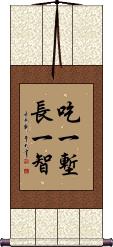
吃一塹長一智 is a Chinese proverb that means “Fall into a moat, and you will gain wisdom from the experience.”
It really suggests that the failures, troubles, frustrations, and setbacks that you encounter in your life are actually helping you to find wisdom. Some would also translate this proverb as “Learn from your mistakes” or “Learn from your experience.”
If you are studying Chinese, you will recognize the first character as “eat,” but in this case, it means to “experience” (as used in this proverb, it is suggesting that you have fallen into a moat and/or had a hard time crossing it).
Translated character by character, this whole proverb is, “Experience one moat, gain one wisdom/knowledge.”
Note: This can be pronounced in Korean, but it's not a commonly used phrase.
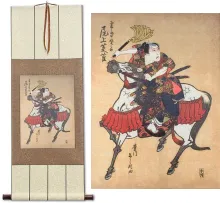
This in-stock artwork might be what you are looking for, and ships right away...
$59.88 ≈ Kč1,250.52